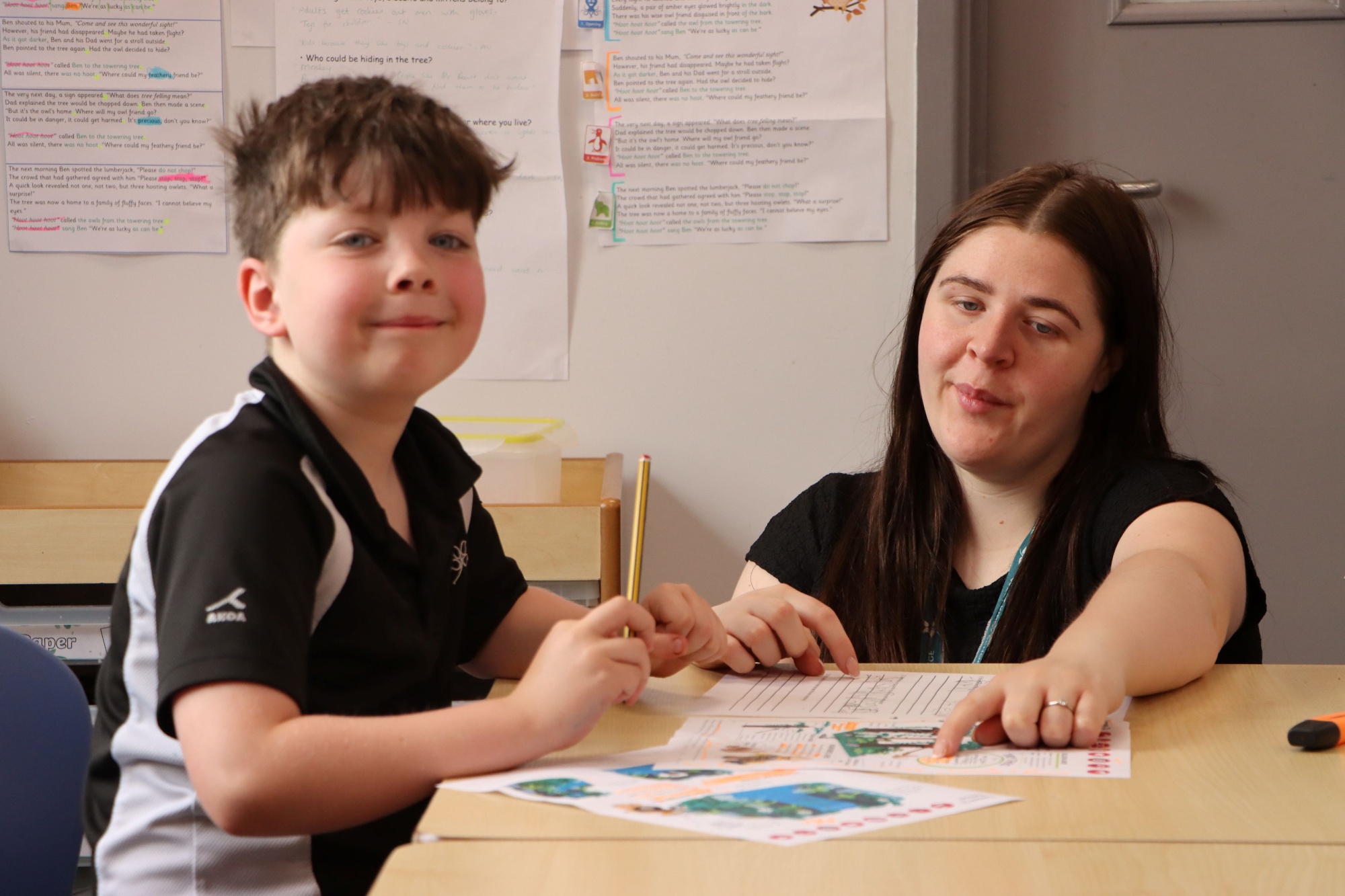
Primary English
English in the Primary Department
At West Kirby School and College, we believe that English is the foundation for communication, learning and lifelong success. Our intent is to develop confident, capable and enthusiastic readers, writers and communicators by providing a broad, inclusive and ambitious English curriculum that meets the needs of every pupil.
Through high-quality reading, writing and oracy experiences, we aim to foster a love of literature, language and storytelling while equipping pupils with the literacy skills needed to access the wider curriculum and the world beyond school. We recognise that many of our pupils face additional barriers to literacy and therefore provide personalised support, targeted interventions and meaningful opportunities to succeed.
Reading is at the heart of our curriculum. Through systematic phonics teaching, shared reading, independent reading, rich literary experiences and a strong culture of Reading for Pleasure, pupils develop fluency, comprehension, vocabulary and confidence as readers. Our carefully curated Reading Spine exposes pupils to diverse authors, cultures, experiences and perspectives, helping them develop empathy, curiosity and an understanding of the world around them.
Writing is inspired by high-quality texts and supported through explicit teaching, purposeful talk and opportunities for creativity. As a Voice 21 school, we recognise the vital role of spoken language in literacy development and provide regular opportunities for pupils to discuss, explain, perform and refine their ideas before transferring them into writing.
We are committed to ensuring that all pupils experience the richness of literature beyond the classroom. Through author and poet visits, theatre trips, visits to libraries and bookshops, Literacy Week, our annual Literacy Festival and community reading projects, pupils engage with language and literature in authentic and memorable ways.
Our aim is for every pupil to leave West Kirby School and College as a confident communicator, a motivated reader, a successful writer, and a lifelong learner with a positive relationship with literacy.
Phonics
At West Kirby School, we deliver synthetic phonics through the Read Write Inc (RWI) programmes, as recommended by the Department for Education. This evidence-based approach supports pupils in developing secure decoding, word recognition, spelling, and early writing skills, while also strengthening speaking and listening.
We use RWI Phonics and RWI Fresh Start, depending on pupils’ age:
Years 1–4: Pupils who don’t have secure phonics receive RWI Phonics.
From Year 5 onwards, pupils who don’t have secure phonics transition to RWI Fresh Start.
Lessons are delivered on a 1:1 basis, enabling highly personalised teaching tailored to each pupil’s individual needs and learning profile. Session lengths are adapted as needed, recognising that some pupils benefit from short breaks to support self-regulation and sustained engagement.
To ensure progress is carefully monitored, pupils are formally assessed every six weeks, allowing trained staff to identify strengths, address gaps, and tailor support effectively. This includes consistently feeding back to teachers, parents and carers on individuals' progress and providing pupils with opportunities to reinforce their learning at home.
Shared Reading
Our shared reading curriculum is built around a carefully sequenced range of high-quality, age-appropriate texts using Literacy Counts’ Ready Steady Read Together units of learning.
This dynamic and inclusive programme incorporates metacognitive reading strategies and introduces pupils to diverse literature from exceptional authors. Through shared reading, we aim to inspire a lifelong love of reading for pleasure, knowledge and information.
We intend that all pupils from Year 2 to Year 6, regardless of need, ability or background, have the opportunity to meet and, where possible, exceed the National Curriculum expectations for reading comprehension.
Through explicit teacher modelling, pupils learn how skilled readers use:
- Expression
- Pace
- Intonation
- Prosody
These elements help pupils understand how meaning is conveyed through fluent reading and how fluency supports deeper comprehension.
Shared reading lessons also provide regular opportunities for:
- Discussion and collaborative thinking
- Purposeful questioning
- Drama and role-play
- Exploration of vocabulary and language choices
These approaches deepen comprehension while simultaneously strengthening pupils’ oracy skills.
Importantly, shared reading ensures that every child, regardless of decoding ability, can access ambitious texts, engage meaningfully with rich literature, and develop the habit of reading widely and often.
Writing
At West Kirby School and College, our writing curriculum is designed to provide a broad, balanced and inclusive education that enables every child to become a confident, independent and successful writer. We believe that all pupils should develop the skills, knowledge and motivation to communicate effectively through writing, regardless of their individual starting points or needs.
Our aim is for every child to develop fluency, creativity, and pride in their written work, leaving primary school as an enthusiastic writer well prepared for the next stage of their education.
Our Writing Curriculum
We follow the Ready Steady Write programme from Literacy Counts, a research-informed and impact-proven approach that supports children in developing the foundational skills needed for effective writing. The programme is carefully sequenced to ensure pupils build knowledge and confidence over time, enabling them to write with increasing independence for a clear audience and purpose.
Through high-quality, vocabulary-rich texts, pupils are immersed in engaging literature that offers meaningful and compelling reasons to write. Carefully selected texts expose children to ambitious vocabulary, varied sentence structures and a wide range of genres, inspiring them to develop their own authorial voice.
Writing is explicitly taught through a range of effective approaches, including:
- Modelled writing, where teachers demonstrate the thinking and decision-making involved in the writing process
- Shared writing, where pupils collaborate with adults and peers to develop ideas and compose text.
- Guided practice, allowing pupils to apply newly learned skills with support;
- Independent writing, where children demonstrate and embed their learning;
- Editing and improving, helping pupils reflect on and refine their work to improve clarity, accuracy and impact.
- Grammar, punctuation and vocabulary are taught in context, ensuring pupils understand how these elements enhance meaning and effectiveness in their writing.
Please click here [add hyperlink to PDF of your Writing Policy] for further information about the intent, implementation and impact of our writing curriculum.
Spoken Language: The Foundation of Writing
At West Kirby School and College, we recognise that strong spoken language underpins successful writing. As a proud Voice 21 school and member of the North West Oracy Group, we place a strong emphasis on the development of oracy across the curriculum.
Children are encouraged to explain, discuss and justify their ideas, while also learning to listen actively and respond thoughtfully to others. Through structured talk opportunities, drama, storytelling and vocabulary exploration, pupils develop the confidence and language skills needed to organise and articulate their ideas before transferring them into writing.
Teachers explicitly teach and revisit ambitious vocabulary, ensuring key words are embedded across lessons and used meaningfully by pupils. All children receive regular constructive feedback on their speaking and listening skills to support effective communication and written expression.
Spelling
For pupils in Years 2 to 6 who read accurately and fluently, we use the Read Write Inc. Spelling programme to develop confident and accurate spellers.
Weekly spelling lessons help pupils to:
- understand word families and spelling patterns;
- explore how prefixes and suffixes affect root words;
- learn spelling rules and exceptions;
- develop strategies and mnemonics to remember challenging spellings.
The spelling of common exception words is regularly revisited, and pupils are encouraged to practise targeted spellings both in school and at home to support retention and application in their writing.
Handwriting and Presentation
At West Kirby School and College, handwriting is recognised as an essential part of literacy and is developed across all areas of the curriculum.
We follow the Read Write Inc. Handwriting Programme, supporting pupils through a structured progression from accurate letter formation to fluent, confident and legible handwriting. While handwriting is currently taught explicitly in Primary lessons, all staff reinforce high expectations for presentation and the consistent application of handwriting skills across all subjects. Selected secondary English lessons will soon also include explicit handwriting instruction.
We are also developing a Fine Motor Control Toolkit Library to further enhance pupils’ readiness for writing. Each toolkit will provide engaging, age-appropriate activities that strengthen hand muscles, improve coordination and refine the dexterity needed for effective handwriting. These resources will be used during shared reading sessions across the school, enabling pupils to develop the physical foundations of writing as they listen to high-quality texts. Alongside this initiative, ongoing staff training will provide teachers with further guidance on handwriting expectations, progression and best practice, ensuring a consistent approach that enables every learner to build confidence, independence and success in written communication.
Working Walls
Each primary classroom features an English working wall designed to support and celebrate the writing process.
These interactive displays provide accessible visual prompts and may include:
modelled examples of current text types;
- key genre features;
- grammatical reminders;
- ambitious vocabulary;
- sentence stems and success criteria;
- examples of pupil work and shared ideas.
Working walls help pupils to apply their learning independently and serve as an ongoing reference throughout each writing unit.
Marking, Feedback and Editing
Regular feedback is an essential part of the writing process and helps pupils understand how to improve their work over time.
Teachers and HLTAs provide daily feedback on pupils’ writing, identifying strengths and next steps. Where appropriate, pupils are encouraged to edit and improve their work using a ‘purple polishing pen’ or pencil, promoting reflection, ownership and independence.
Through self-assessment and guided editing opportunities, children learn that writing is a process of drafting, refining and improving.
Monitoring Standards
The quality of English teaching and learning is closely monitored by teachers, the Senior Leadership Team and the English Subject Leaders to ensure consistently high standards across the school.
This includes:
- regular book reviews;
- moderation of writing across classes and key stages;
- staff training and professional development;
- lesson visits and support;
- termly assessment and data analysis.
This ongoing monitoring enables us to celebrate success, identify areas for development and ensure that every child receives the support they need to make strong progress in writing.